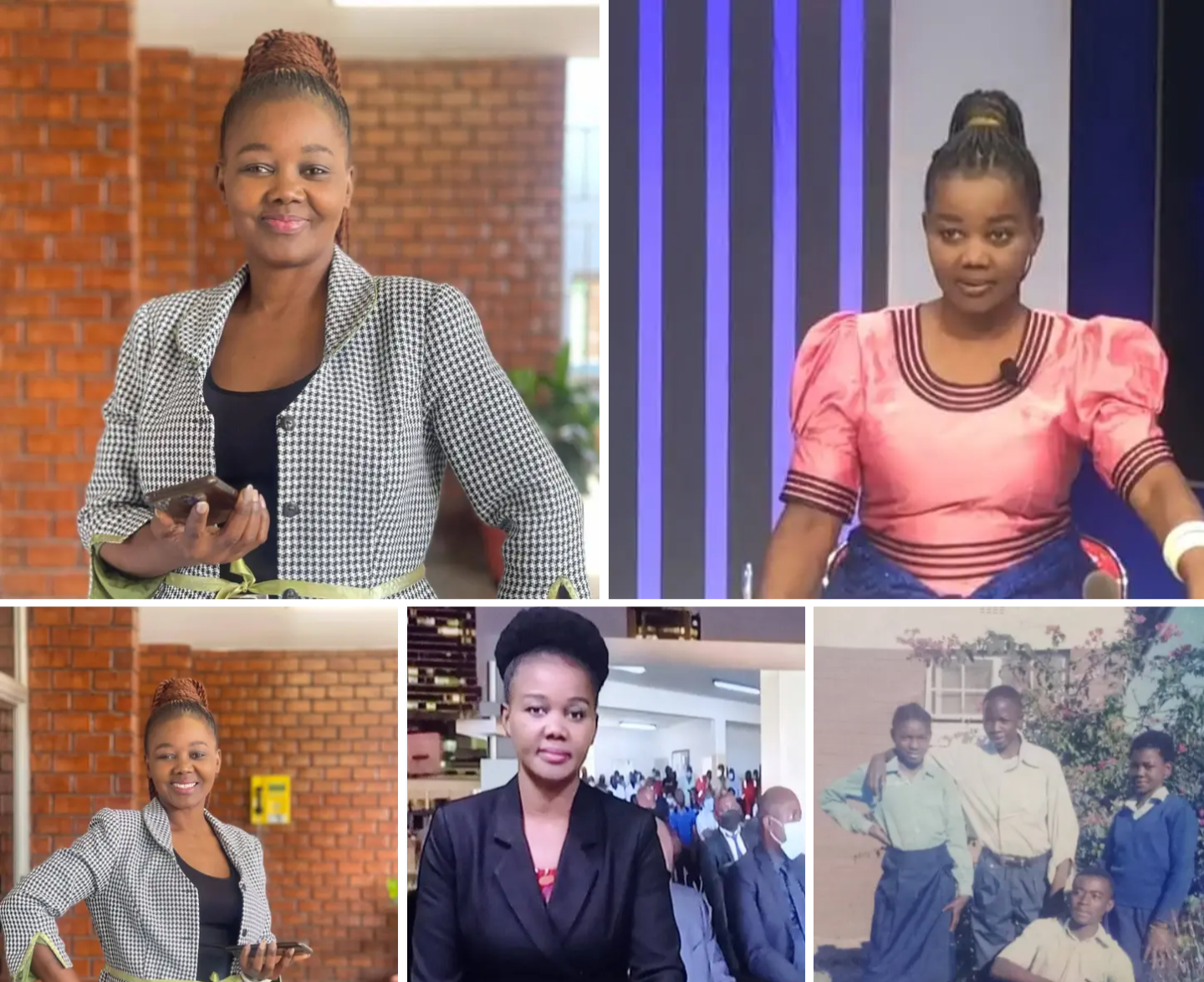
WHEN you meet Mutukwa Mooya, the first thing you notice is her natural beauty. The kind that doesn’t beg for attention but gets it anyway! She is bubbly and speaks King Charles III’s language as seamlessly as the Litunga’s language.
Mutukwa also has a way of making you feel seen within minutes of a conversation. She is the kind that will make you feel whoever said, “never meet your heros,” was just delusional.
There is something deeply maternal about Mutukwa’s presence, the kind that naturally draws people in.
But behind that soft, welcoming personality lies a powerful woman who came from a humble background where it was almost impossible to make it in life.
Despite the challenges of coming from a big family that almost had nothing, Mutukwa is now the Head of the Silozi Section at the Zambia National Broadcasting Corporation (ZNBC).
She was born and bred in Mongu’s Limulunga area, Western Province and grew up in a humble, polygamous family as the second last child in a household of 17 siblings from her father’s side and 10 from her mum’s.
She lost her father in 1989 while she was in Grade Three, a moment that would later redefine her path.
Raised largely by her mother, older sisters and nieces whom she describes as “like my mothers,” Mutukwa learned early what it meant to rely on family and inner strength.
Her education journey took her through Nango’ko, Imwiko and Mulambwa Primary Schools before proceeding to Senanga Secondary School and eventually Holy Cross Secondary School between 1996 and 1998.
Growing up, Mutukwa would always picture herself on TV reading the news.
She shared that her 85 year old humble, educated mother is a happy person as she says her daughter has become what she really wanted from childhood and Mutukwa says she does it all for her mum.
“At the age of six, I already knew I wanted to be a journalist,” she told Kalemba in an interview.
She recalled that listening to Radio One and Two was always her favourite adventure which made her develop a deep fascination with broadcasting, particularly in local languages.
That passion led her to Evelyn Hone College where she pursued a Diploma in Journalism and Public Relations from 2000 to 2003.
After Evelyn Hone, she gained more knowledge as an intern through writing stories with the Pan African News Agency (PANA Press) in Lusaka before joining ZNBC.
During her industrial attachment in 2002 at ZANIS, Mutukwa would often find herself drawn to the Silozi section at ZNBC during lunch breaks, quietly observing, learning and building relationships.
It was here that the dream began to take shape.
In 2005, that dream became reality, joining ZNBC as a trainee announcer on March 8, 2005.
Over the years, she has steadily climbed the ranks from announcer to producer, to senior producer in 2013 and eventually, in 2016, to Head of the Silozi Section till date.
She oversees content production for both radio and television, ensuring quality, coordinating teams and occasionally stepping behind the microphone as a presenter and newscaster in both Silozi and English.
Mutukwa is also widely recognised for her voice in environmental journalism.
“In 2009, I introduced “Libaka Za Luna,” a programme focused on environmental awareness, driven by my belief that climate action must be communicated in languages people understand,” she said.
“In times like these when the major story in the world is climate change, every action on the environment must be user-friendly.”
Her commitment has earned her several accolades, including the SADC Media Award in 2010 for a documentary on climate change, as well as recognition from environmental bodies for her work in development journalism.
To her, climate action is not just a concept but a call to action rooted in community engagement.
She speaks passionately about climate financing, justice, resilience, adaptation and restoration, ideas she actively translates into local language programming for rural audiences.
She has also been recognised by the Zambia Environmental Management Authority (ZEMA) for her outstanding work in environment and development journalism.
In 2013, she received a Certificate of Achievement for exceptional science and technology coverage during the 11th National Science and Technology Week.
Her excellence in climate reporting was further recognised in 2015 when she received the Climate Change Media Award from the Climate Change Secretariat under the Ministry of Finance and National Planning.
She is also a board member of the Africa Leadership Transformation (ALT) foundation, whose vision is to transform leadership as a key to an Africa that works for everyone.
Outside the newsroom, Mutukwa is a singer in her own private space, fitness enthusiast who does aerobics with her children and a devoted member of the Women Christian Fellowship (Bana KBBK) in the United Church of Zambia, which she joined in 2011.
She is also a wife and mother of four, having married her husband in 2004 after meeting at Evelyn Hone College.
“It started in a simple way. We had nothing. Our marriage built from scratch, but strengthened by mutual respect, including freedom of worship in our home. He is SDA, I’m UCZ.”
Academically, she has continued to grow, earning a Bachelor of Arts in Communication Science from the University of South Africa in 2017 and currently pursuing a Master’s in Communication for Development at the University of Zambia.
Despite her achievements, she acknowledges the challenges that come with working in local language media.
“People think we are not educated because we use local languages, but you actually need to be very good in English to do this work because it requires a lot of translation to and from English lest you misinform the public,” she explained.
She added that speaking English only should not be a measure of education anyway.
She also noted the difficulty in getting sources to comfortably express themselves in local languages on air, a gap she continues to bridge through her work.
Looking ahead, Mutukwa, who is in her early 40’s is open to the idea of venturing into politics, driven by her passion for people and community development.
She told Kalemba that she wants to be remembered as someone who taught communities how to care for their environment.
In her work as a journalist passionate about climate change and the environment, Mutukwa said getting sponsors and sources has been challenging.
“In times like these, when the major story in the world is about continuous negative changes in the climate, every action on the environment must be user friendly, so the key word here is ‘Climate Action’. And through massive dissemination of this Information to the highly affected people in rural areas, through radio in their mother tongue, this is action oriented,” she said.
“I believe climate mitigation actions can be done through climate financing, climate justice, climate resilience, climate adaptation and climate restoration.”
She appealed to institutions and organisations dealing with climate change issues to work with producers of local language content.
“My appeal is that they work with us because the majority of environmental degradation and climate change happens in rural areas, thus the need to educate these populations to be proactive,” she appealed.
“It’s also challenge because some organisations think they won’t be seen just because their funders are bazungus or so, yet our worry should be to act and cure this environmental degradation problem at hand.”
And for young girls, especially those from humble beginnings, her message is just as powerful.
“You can be anything with the right attitude and push. I have what I call the four dress principle which is, school uniform then graduation gown then wedding dress and finally maternity dress,” she said.
To the girl child trying to look for women to learn from and be inspired, Mutukwa is the right plug.
By Catherine Pule
Kalemba, March 20, 2026